
Does My Business Need Emergency Exit Signs in NZ?
For many commercial property owners across Northland and Auckland, emergency exit signs are something they don’t notice until there’s an issue.
Clear, visible emergency signage plays an important role in helping people safely leave a building during an emergency, especially in an emergency like a fire or power outage.
So, does your business need emergency exit signs in NZ?
The answer depends on your building, its use, and the safety systems installed. Under New Zealand’s building safety requirements, many commercial buildings are required to have emergency signage as part of their fire safety systems.
Understanding your obligations helps ensure your building remains safe, compliant, and ready when it matters most.
Which Buildings Need Emergency Signage?
Emergency signs are generally required in commercial buildings where people may need assistance finding their way out during an emergency.
This commonly includes:
- Offices and commercial workplaces
- Retail stores and shopping facilities
- Schools and education facilities
- Warehouses and industrial buildings
- Community facilities
- Restaurants and hospitality venues
- Multi-unit commercial or public buildings
The exact requirements depend on factors such as the building’s use, size, layout, occupancy, and the safety systems installed.
For example, a small office with limited occupancy may have different requirements compared to a large retail premises, warehouse, or public facility where many people are present.
A qualified fire safety professional can assess your building and help determine what systems are required.
Why Emergency Exit Signs Matter for Commercial Fire Safety
During a fire or other emergency, conditions can change quickly. Smoke can reduce visibility, power can fail, and people may not know the building layout to be able to make a quick escape.
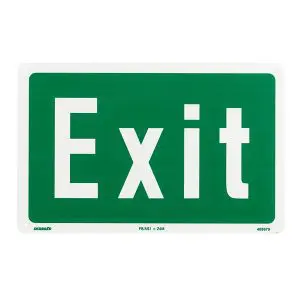
Emergency exit signs help occupants identify evacuation routes and locate safe exits quickly.
Effective emergency signage should be:
- Clearly visible
- Correctly positioned
- Illuminated where required
- Kept free from obstruction
- Regularly maintained and tested
A sign that is hidden, damaged, not illuminated or no longer visible may not provide the protection it is designed to offer.
How Emergency Signage Requirements Vary by Building Use
Factors that can influence your emergency signage requirements include:
- Building size and layout: Larger buildings with complex layouts and multiple evacuation routes will likely require more signage and emergency lighting systems.
- Number of occupants: Buildings with higher occupancy levels need clear evacuation pathways so people can exit quickly and safely.
- Building purpose: A warehouse, office, school, and hospitality venue may all have different fire safety considerations based on how the space is used.
- Existing safety systems: Emergency signage often works alongside other fire safety systems, including emergency lighting, fire alarms, and evacuation procedures.
Understanding these requirements is an important part of maintaining good commercial building fire safety in NZ.
Emergency Exit Signs and BWOF Requirements
For many commercial property owners, emergency signage is closely connected to their Building Warrant of Fitness (BWOF) obligations.
A BWOF confirms that a building’s specified systems are being maintained, inspected, and operating as required under its compliance schedule.
Specified systems can include important safety features such as:
- Emergency lighting systems
- Fire alarm systems
- Automatic doors
- Signs relating to fire safety systems
- Other systems identified on the building’s compliance schedule
The exact systems included in a BWOF depend on the individual building and its compliance schedule.
If your building requires a BWOF, keeping specified systems maintained and ensuring inspection records are up to date is essential. Falling behind on servicing or inspections can create compliance issues and leave your building less prepared in an emergency.
The Importance of Regular Emergency Signage Checks
Like any specified system, emergency signage needs ongoing maintenance and IQP checks, as part of the NZ BWOF process.
Regular checks help identify issues such as:
- Failed illuminated exit signs
- Damaged signage
- Faulty backup batteries
- Obstructed evacuation routes
- Changes to building layouts that affect signage placement
Routine inspections and maintenance help ensure your systems continue to perform as intended and support your ongoing compliance responsibilities.
Working with an IQP and Fire Safety Provider
Navigating BWOF requirements and commercial fire safety in NZ can feel complicated, particularly when multiple systems and compliance obligations are involved.
Working with an experienced Independent Qualified Person (IQP) from Fireco’s network can help simplify the process.
At Fireco, we support businesses across Northland and Auckland with IQP specified systems inspections and maintenance, as well as
- Fire alarm installation, testing, and servicing
- Fire equipment servicing
- BWOF compliance support
- Fire safety advice tailored to your building
Our team works with property owners, facility managers, and businesses in Northland and Auckland to keep their fire protection systems are maintained and compliant with NZ safety standards.
Need Help With Emergency Signage Compliance?
If you’re unsure whether your building’s emergency exit signs and fire safety systems meet current requirements, Fireco can help.
Our experienced team can supply emergency signage, along with practical advice, inspections, servicing, and ongoing compliance support for commercial properties throughout Northland and Auckland.
Get in touch with Fireco today to discuss your building’s fire safety requirements.